In November 2026, a developer took 100 AI-written texts, stuffed each one with hidden characters, cleaned them, and scored both versions. The median score change was zero.
That will sting if you were counting on a quick scrub to make a draft pass as human. It doesn’t close the case, though. “Watermark removal” can mean deleting invisible characters, or it can mean rewriting the words, and detectors react to those two jobs in completely different ways.
A note on method: we didn’t run a new lab test for this piece. We went through the most recent published tests instead, and we’ve kept their weak spots in view, because several were run by companies with something to sell.
Two Very Different Things Get Called a Watermark
Most confusion here starts with the word itself. It covers two separate things, and a tool that handles one may do nothing about the other.
Hidden characters
These are real characters sitting in your text: zero-width spaces, narrow no-break spaces and similar oddities. Rumi drew attention to them in April 2025 after finding narrow no-break spaces in output from OpenAI’s o3 and o4-mini. OpenAI’s reply, reported by Aragon Research (2025), was that they were a quirk of reinforcement learning and not an intentional watermark. Because they’re characters, you can delete them.
Provider watermarks
These live in word choice, so there’s nothing to delete. Anthropic uses a version of Google DeepMind’s SynthID Text for Claude (The Decoder, 2026), and OpenAI announced its textGrain watermark for ChatGPT and Codex output in the EU in October 2026 (Metir AI, 2026). Reading one takes the provider’s private key. Anthropic’s support page says its own detection is still in private preview for eligible groups.
Everyday AI detectors do something else again. They judge the writing, which explains why the results below split the way they do.
What the Published Detector Tests Actually Found
| Test | What changed | Result | Main caveat |
| SuperLede, Nov 2026 | Hidden characters only, 100 texts | 96 of 100 stayed within 5 points | One detector, owned by the tester |
| Originality.ai, 2025 | Hidden characters only, 2 texts | Most tools still detected the AI text | Very small sample |
| University of Notre Dame, Aug 2026 | Full rewrite by one humanizer, 2,568 pairs | Under 4% still flagged | Academic abstracts, two detectors |
| Originality.ai, Nov 2026 | Rewrites from 16 and 11 humanizers | 89.8% and 96.0% caught | Detector vendor reporting its own score |
Hidden Character Cleanup Barely Moved the Needle
SuperLede’s test added about 59 hidden characters to each text, then compared scores before and after cleaning, averaging three runs per version. The median change was 0 points. Only 3 of the 100 texts changed verdict, although one dropped by 33 points, so outliers do happen.
Keep the limits in mind. SuperLede built both the cleaner and the detector, and the characters were planted for the experiment. Originality.ai’s much smaller 2025 check landed in the same place, though: its AI samples stayed detectable by most tools with or without the characters.
Rewriting Moved Scores, but Not Predictably
Change the words and the picture flips. Researchers at the University of Notre Dame (Karr et al., 2026) ran AI-rewritten academic abstracts through Undetectable AI, then scored them with Pangram 3.2 and GPTZero.
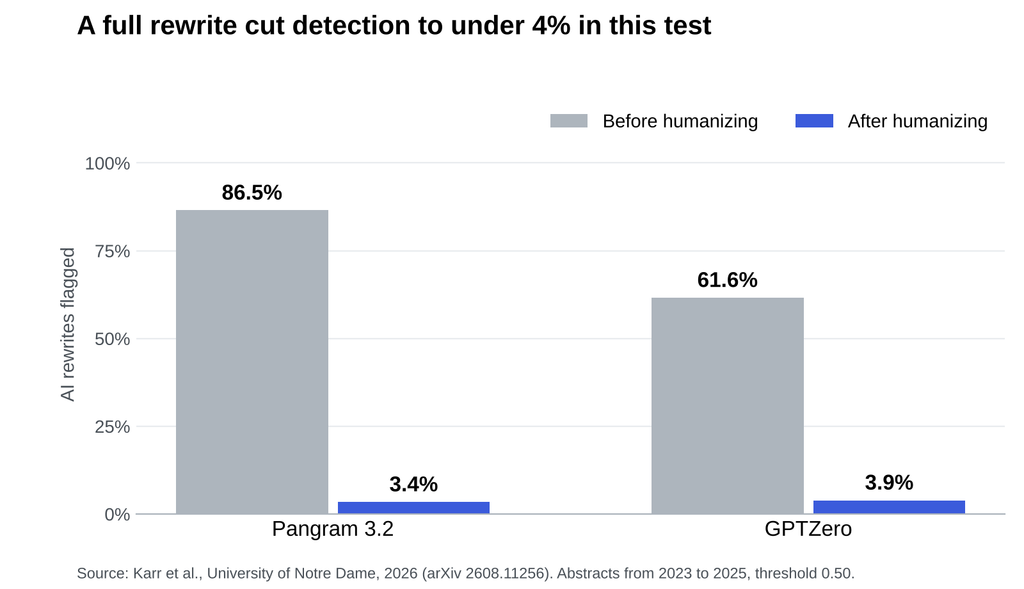
Share of AI-rewritten abstracts from 2023 to 2025 flagged at a 0.50 threshold, calculated from reported false negative rates. Source: Karr et al., University of Notre Dame, 2026.
Before you read that as “rewriting beats detectors,” look at the other side of the ledger. In two benchmarks from October 2026, Originality.ai reports that its 5.0 model caught 431 of 480 humanized rewrites (89.8%) and 528 of 550 (96.0%). Both benchmarks were run by humanizer companies, and the detector vendor published the write-up, so nobody in that chain is neutral.
The two sets of numbers can’t be compared directly, since the tools, detectors and text types all differ. What they do show is that a rewrite’s result depends heavily on which detector reads it. A pass on one tool tells you very little about the next.
Provider Watermarks Can’t Be Checked at Home
Paraphrasing does seem to damage statistical watermarks. A 2026 preprint by Tamim and Khan found it erased 58 of 59 detectable marks from a research version of SynthID Text. That same setup only spotted 6 of 30 untouched samples, however, and it used short passages and not a production system.
For ordinary users, the bigger issue is verification. Without access to the provider’s detector, you can’t confirm a mark is gone, and Anthropic says plainly that a missing mark doesn’t mean text wasn’t AI-generated.
Where Removing Watermarks Genuinely Pays Off
So does cleanup matter at all? Yes, and one result makes the case nicely. Shill and Nandi (2026) tested nine research detectors on a sample of 27,029 texts and inserted zero-width characters into human writing. One detector, LogLik, then flagged 98% of those human texts as AI. After sanitizing, that fell to 1%. Another detector, FDG-neo, went the opposite way, with its catch rate on AI text sliding from 69% to 6%. These aren’t the commercial tools most people use, and the characters were inserted on purpose, but the lesson holds: stray characters can distort a reading in either direction.
There’s a plainer reason too. Hidden characters travel with your copy into content systems, spreadsheets and code, where they can cause odd line breaks and failed searches. If you want to remove watermarks from AI text before it goes live, Phrasly’s tool offers Easy, Medium and Aggressive levels, so you can pick how much of the draft gets touched. Start low. You can always go further.
The Hidden Cost of a Heavy Rewrite
Chasing a lower score has a price, and it rarely shows up in the score itself. A preprint by Wang, Zhu and Chen (2026) audited 11 commercial humanizers on a public leaderboard. Every tool changed or dropped at least one checkable detail, such as a number, date, name or quoted phrase, in 35% to 65% of the documents containing one.
The sample was modest, with 20 eligible documents per tool, and the fact checker has its own error rate. Still, a changed statistic is a far worse problem than a middling detector score. That’s why it helps to lock your claims, key terms and CTAs before any AI edit and compare the result against your source afterward.
A Five-Minute Test to Run on Your Own Draft
Published results are useful, but your text is the one that counts. This quick routine shows what cleanup actually does to it:
- Save an untouched copy, then score it three times in an AI detector, since scores can vary between runs.
- Clean the draft at the lightest setting and score it the same way.
- Check every number, name, date and quotation against the original.
- Move to a stronger setting only if the writing itself still needs work.
- Read the final version aloud and fix anything you wouldn’t say yourself.
One caution applies throughout. Cleaning text doesn’t change any disclosure rule set by your school, employer or publisher, so check those first.
Clean the Text for Your Readers, Not for a Score
Removing hidden characters is worth doing because it gives you tidier, safer copy, but the published tests suggest it won’t do much to an AI score. Rewriting can move that score a long way, with results that swing from one detector to the next and a real risk to your facts. Treat watermark removal as the last step of a careful edit. The draft that holds up is the one you’ve checked line by line and would happily put your name on.